
Campus Microgrid
Build the Power System and the Compute Campus Together.
Located in Pittsburg, Oklahoma, Energy Compute Campus designs campuses where on-site generation, medium-voltage distribution, and compute infrastructure are planned as one integrated architecture — not assembled from separate vendors with separate interests.
Gigawatt+
Generation Capacity
Phased across units
2
Independent Power Trains
A and B, continuously energized
500 Acres
Campus Footprint
Master-planned site
24/7
Operations Coverage
Plant, compute, security
The Conventional Approach
Traditional Data Center Power Design Has a Structural Problem
The conventional model made sense for an earlier era. It is not the right architecture for gigawatt-scale AI and HPC campuses.
Most data centers are built on a familiar model: utility power as the primary source, a farm of standby generators as backup, and a transfer-based architecture that connects them. Halls are designed independently. Electrical systems are assembled by domain rather than planned as a campus. Utility availability is assumed, not engineered around.
At moderate scale, this model functions. At gigawatt scale — with large AI training clusters, high-density HPC, and multi-year deployment horizons — its constraints become structural liabilities: utility queue exposure, fragmented distribution, backup-power thinking embedded in the architecture, and limited ability to expand without revisiting the entire electrical strategy.
Utility Dependency
Large deployments face multi-year interconnection queues. Utility availability determines deployment timing, not the other way around.
Fragmented Distribution
Hall-by-hall generator and UPS design creates inconsistent power paths, complex switchgear coordination, and difficult expansion logic.
Backup-Power Architecture
Transfer-based thinking treats onsite generation as insurance rather than primary infrastructure. The architecture reflects that framing at every level.
Scaling Penalty
Adding capacity often means rethinking the entire electrical strategy. The architecture does not extend cleanly — it accumulates exceptions.
Misaligned Planning Horizons
Utility timelines, campus construction, and compute deployment operate on separate schedules with no inherent coordination mechanism.
Campus Microgrid
A Site-Level Resilient Power Architecture
The campus microgrid is not a backup-generator strategy. It is a purpose-built, site-level power system where generation, distribution, and compute infrastructure are designed together from the beginning.
Two independent generation trains — each capable of supporting the full critical campus load — feed two independent medium-voltage distribution rings. Every data center pod receives A and B feeds. Local transformers convert to utilization voltage. UPS-backed critical distribution delivers continuously available power to dual-corded IT loads.
Optional utility interconnection is preserved as a separate path — for grid export, market participation, or supplemental import — but it is logically decoupled from the core critical continuity architecture. The campus does not depend on utility availability for IT power continuity.
From Fuel to Rack
How Power Flows Through the Campus
A structured, step-by-step architecture — from primary fuel supply through to dual-corded IT equipment.
01
Fuel Delivery & Conditioning
Natural gas is delivered to the campus, conditioned to specification, and distributed to generation units. On-site storage provides buffer against supply interruptions.
02
Generation — Trains A & B
Multiple generation units per train produce electrical power. Each train operates independently and is sized to support the full critical campus load without the other.
03
Plant Bus & Protection
Generated power is collected at the plant bus. Plant-level switchgear, relay protection, and metering govern output and protect the generation assets.
04
Campus MV Distribution
Independent medium-voltage rings — Ring A and Ring B — distribute power from the plant across campus. Each ring is physically and electrically separated.
05
Pod Transformers & Switchgear
Each data center pod receives dedicated A and B medium-voltage feeds. Local transformers step down to utilization voltage. Pod-level switchgear provides isolation and protection.
06
UPS-Backed Critical Distribution
A and B critical power paths are each backed by independent UPS systems. Critical distribution panels deliver conditioned, UPS-backed power to the IT environment.
07
Dual-Corded IT Loads
IT equipment is dual-corded — receiving both A and B sources simultaneously. No single-point source transfer is required. Both paths are continuously energized.
08
Optional Grid Intertie
Utility interconnection is available as a separate logical path. It supports grid export, market participation, or supplemental import — but is isolated from the core critical IT continuity architecture.
Differentiation
Why the Campus Microgrid Model Is Different
Prime-Power Architecture
Generation is primary infrastructure — not backup. Both trains are continuously energized and sized for full-load operation. There is no standby mode.
True A/B Path Independence
Campus MV rings, pod feeds, UPS systems, and critical distribution are physically and electrically independent. A failure in one path does not affect the other.
No Source-Transfer Dependency
Dual-corded IT loads are simultaneously fed from both live sources. Traditional ATS-based source transfer is not the defining element of the critical-path architecture.
Campus-Scale Distribution
Medium-voltage rings distribute power across the entire campus — not building by building. Every pod connects to the same resilient architecture regardless of phase.
Expansion Without Rearchitecting
The campus MV ring and A/B generation framework extends cleanly to new phases. Adding pods means connecting to existing architecture — not redesigning it.
Utility Constraint Reduction
The campus does not depend on utility interconnection for IT continuity. Large deployments can proceed on campus-driven timelines rather than utility queue schedules.
AI and HPC Power Density Alignment
The architecture is designed for high-density compute from day one — not retrofitted. Power density planning, cooling integration, and distribution sizing reflect AI/HPC workload reality.
One System, One Operating Model
Generation, distribution, compute, cooling, and operations are governed as one integrated campus platform. No siloed operators. No interface gaps.
Comparison
Traditional Backup Model vs. Campus Microgrid
Two fundamentally different philosophies for powering large-scale compute infrastructure.
Traditional Backup Model
Primary Power
Utility grid
Onsite Generation
Standby / emergency backup only
Distribution Model
Hall-by-hall, building-level generators
Critical Path
Transfer-based — ATS or STS switching events
Utility Dependency
High — utility availability drives deployment
Expansion Logic
Each expansion may require new electrical strategy
Scale Behavior
Increasing complexity per MW added
AI/HPC Alignment
Retrofitted to higher densities — not native
Campus Microgrid
Primary Power
On-site generation — Trains A and B
Onsite Generation
Primary and continuously energized
Distribution Model
Campus MV rings A and B — all pods
Critical Path
Dual-corded IT loads, both sources live simultaneously
Utility Dependency
Low — optional intertie, not critical-path dependency
Expansion Logic
New pods connect to existing A/B architecture
Scale Behavior
Architecture extends without structural changes
AI/HPC Alignment
Designed for high-density compute from day one
Site Planning
Campus Design Principles
The campus is master-planned as a whole — generation, distribution, compute zones, operations, and expansion areas — not assembled incrementally.
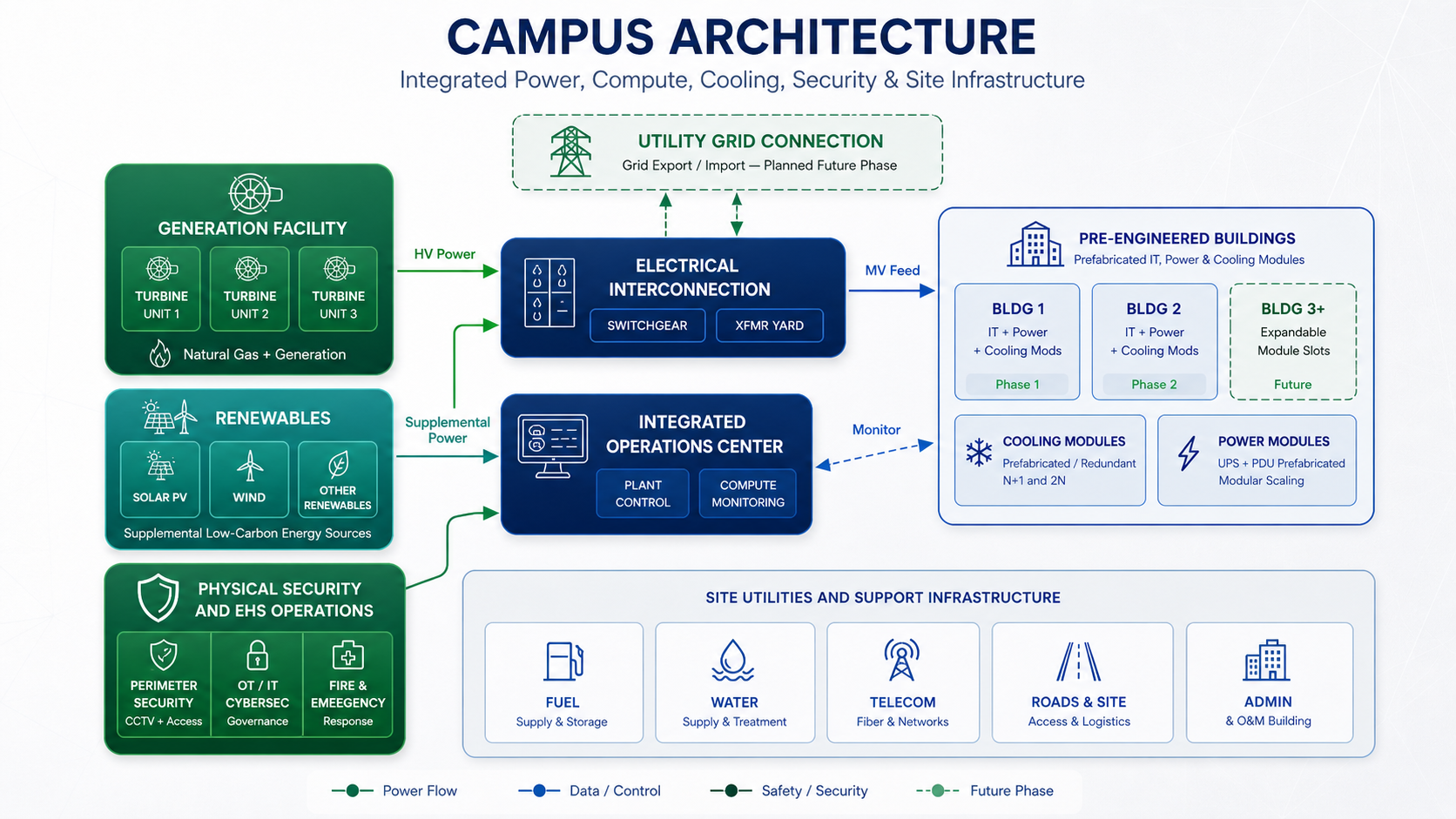
Physical site layout follows electrical architecture. A and B generation trains and distribution rings inform how compute pods are positioned, how cooling infrastructure is oriented, and how expansion phases are sequenced. The campus plan reflects the power plan.
View Operations ModelGeneration Plant
Dual-train generation facility, fuel conditioning, plant-level switchgear and relay protection.
Electrical Yard
HV/MV substation, transformer bays, campus ring feed points, and optional utility interconnection.
Data Center Zones
Pre-engineered buildings with prefab IT modules, each connected to dedicated A and B campus feeds.
Campus Operations Center
Integrated plant control, compute NOC, security operations, and emergency response in one facility.
Cooling Infrastructure
Cooling and heat rejection equipment oriented to redundant power paths — not independent of them.
Expansion-Ready Master Plan
Future phase areas are reserved and electrically pre-planned. Expansion connects — it does not disrupt.
Audience
Who the Campus Microgrid Model Is Built For
Hyperscalers & AI Cloud Operators
Large-load, long-term tenants requiring a power architecture that matches the density, reliability, and continuity demands of frontier AI training and inference workloads.
Enterprise AI & HPC
Organizations deploying proprietary AI infrastructure at scale who need colocation with a power model designed for high-density compute — not retrofitted to it.
Energy Developers Entering Compute
Energy companies and project developers seeking a repeatable, structured framework for bringing generation assets into the data center market.
Landowners & Site Developers
Landowners and real estate developers with large-format sites in markets with natural gas access and transmission proximity, seeking structured development frameworks.
Utility-Constrained Markets
Operators in markets where utility interconnection queues, grid constraints, or transmission limitations make traditional data center deployment timelines impractical at scale.
Partners & Capital
Investors, institutional capital, and strategic partners seeking a standardized, documented, and repeatable campus deployment model with clear development and operating frameworks.
Strategic Benefits
A Better Business Model for Large-Scale Compute
The Campus Microgrid architecture is not only an engineering choice. It is a deployment strategy, a capital model, and a long-term operating framework.
Deployment Speed
Removing utility interconnection from the critical path reduces exposure to multi-year queue timelines. Campus energization follows construction readiness, not transmission availability.
Campus Standardization
The A/B generation, distribution, and pod architecture is repeatable across phases and sites. The same framework — same procurement, same commissioning logic, same operating model — scales without reinvention.
Phased Capital Planning
Generation units, distribution rings, and pod builds can be sequenced independently. Capital follows demand rather than being committed upfront for full campus buildout.
Infrastructure Repeatability
A standardized campus model reduces engineering risk on each successive deployment. Pre-engineered buildings, prefab modules, and documented electrical architecture minimize first-of-a-kind exposure.
Long-Term Operating Model
One campus operator, one maintenance framework, one documentation system, one escalation path. The integrated model is simpler to run at steady state than a fragmented multi-vendor arrangement.
Market Flexibility
Optional utility interconnection preserves the ability to participate in grid markets — capacity, energy, or ancillary services — as campus economics and regulatory conditions evolve.
Site Strategy
Regional Siting for Campus Microgrid Development
Site location decisions are informed by natural gas supply, transmission proximity, water access, workforce depth, permitting environment, and land availability at campus scale. The right site for a campus microgrid is not the same as the right site for a conventional data center.
- Natural gas supply and pipeline infrastructure
- Transmission capacity and interconnection proximity
- Water availability and treatment requirements
- Permitting and regulatory environment
- Workforce and contractor market depth
Load Release Discipline
Load is not released without a formal readiness review. Each milestone — from first energization through staged load steps — requires verified commissioning data, safety sign-offs, and documented operational readiness.
Actual load release milestones will be defined in project-specific operating procedures.
Built with GridCore

The Model for Modern Data Center Campuses
Energy Compute Campus is built with GridCore — a repeatable development, delivery, and operating framework for turning qualified sites into compute-ready infrastructure platforms. Applying GridCore to ECC means every component, from the generation facility and medium-voltage distribution rings to pre-engineered buildings, cooling modules, connectivity fabric, safety programs, and the operations center, is coordinated under one governed campus model.
ECC is one implementation of the GridCore model, focused on a self-generation primary / islanded campus strategy with future grid optionality. Other GridCore campuses may be utility-fed, grid-interactive, hybrid, independently operated, or delivered through different service models.
Learn More about GridCoreRepeatable Framework
GridCore is not a one-off design. It is a structured, reproducible framework that can be applied across sites, power strategies, and deployment architectures.
One Governed Campus System
Land, power, buildings, cooling, connectivity, safety, security, and operations are coordinated through explicit authority, documented interfaces, and disciplined operating rules.
Multiple Deployment Modes
GridCore supports turnkey colocation, powered shell, powered land, and modular buildings — including high-density AI and HPC environments at any scale.
Built for Diligence
Program maturity with evidence, records, and governance to support customer assurance, lender diligence, and long-term operational accountability.
Capacity Release Schedule
100–250 MW Every ~8 Months to 2 GW+
View Reservation DetailsQ1 2027
100–250 MW
100–250 MW
OpenQ3 2027
+100–250 MW
200–500 MW
Q2 2028
+100–250 MW
300–750 MW
Q1 2029
+100–250 MW
400 MW–1 GW
Q3 2029
+100–250 MW
500 MW–1.25 GW
Q1 2030
+100–250 MW
600 MW–1.5 GW
Q3 2030
+100–250 MW
700 MW–1.75 GW
Q1 2031
+100–250 MW
800 MW–2 GW
Q3 2031
+100–250 MW
900 MW–2 GW+
Q1 2032
+100–250 MW
1–2 GW+
All dates are target estimates subject to construction progress, permitting, and commercial execution.
Reserve Capacity Today.
First energization is scheduled for 2027. Reservations from 1 MW to 250 MW are open now across all service models.